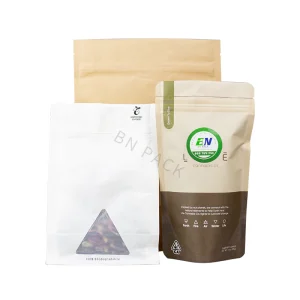
Yes. Personalized packaging can work very well for roasted coffee beans when the bag is built around oxygen control, moisture resistance, degassing, sealing, and food-contact compliance rather than graphics alone. A 2014 Food Research International study confirmed that roasted Arabica retains substantial CO₂ after roasting and releases it gradually during storage, which explains the widespread use of one-way valves. Packaging also has to limit oxygen exposure because roasted coffee oils and aroma compounds oxidize during storage. For brands selling 250 g, 340 g, 500 g, or 1 kg formats, custom printing can add origin, roast, brewing, and traceability information without changing the protective function of the pack.
Roasting creates carbon dioxide inside the porous structure of the bean. Research published by Wang and Lim in Food Research International in 2014 found that roasting temperature and roast time influence both retained CO₂ and its later release rate. Fresh beans therefore continue releasing gas after they enter the package, while aroma compounds are also leaving the coffee.
A sealed bag with no pressure-release route can expand as CO₂ accumulates. Leaving the package open for long periods solves the pressure problem but exposes the coffee to oxygen, so commercial roasters commonly use a one-way degassing valve that lets internal gas leave while restricting outside air.
The package has to manage two opposite movements: CO₂ needs a controlled exit, while oxygen should have as little access to the beans as the package specification allows.
That requirement affects personalized packaging from the first design stage. Valve position cannot be treated like decoration because printing, zipper placement, sealing areas, gussets, and the available headspace all occupy physical space on a 250 g or 1 kg pouch.
Oxygen control deserves similar attention. Roasted coffee contains lipids and hundreds of volatile compounds associated with aroma, and oxygen exposure speeds chemical changes after roasting. A bag can look premium while offering poor storage performance if its film allows too much oxygen to pass through.
For that reason, buyers normally compare oxygen transmission rate, or OTR, rather than judging protection from film thickness alone. A 100-micron film is not automatically better than an 80-micron structure; polymer type, metallization, coatings, adhesive layers, and manufacturing quality can change barrier performance considerably.
The same applies to moisture. Roasted beans are low-moisture food, but water vapor entering the pack can alter storage conditions, while poor sealing can expose the product to ambient humidity every day. FDA food-contact guidance classifies dry foods separately and lists dry solids with and without free surface oil among its food categories.
Food-contact compliance also covers more than the inner film. Under US FDA guidance, polymers, adhesives, coatings, colorants, and other substances reasonably expected to migrate into food have to fall under an applicable authorization, regulation, GRAS basis, prior sanction, threshold exemption, or effective Food Contact Substance Notification.
That matters when artwork becomes more complex. Personalized bags may use several inks, adhesives, laminated films, matte coatings, metallic layers, zippers, and valves, so the finished package should be evaluated as a complete food-contact system rather than as a printed sheet.
| Packaging point | What a roaster should verify | Practical reference |
|---|---|---|
| Fill size | Actual bean volume, not weight alone | Test 250 g, 340 g, 500 g or 1 kg fills |
| Degassing | Valve position and pressure behavior | Particularly relevant soon after roasting |
| Oxygen barrier | Supplier OTR specification | Compare complete film structures |
| Moisture barrier | Supplier WVTR specification | Check expected storage climate |
| Seal | Temperature window and seal strength | Test with actual filling equipment |
| Food contact | Film, adhesive, ink and coating status | FDA rules include 21 CFR 174–179 |
Personalization becomes more useful when a roaster manages several coffees at once. A single business might sell an espresso blend, a decaf, two year-round origins and four rotating releases, creating eight SKUs whose packaging information can change at different times.
Ordering 20,000 printed bags for every SKU can therefore produce 160,000 pieces of packaging inventory even before the coffee is sold. If a seasonal origin lasts only four months, unused printed bags can become unusable when the crop, tasting description, certification, roast information, or supplier changes.
Digital printing offers another route because designs can be changed between shorter production runs without the plate or cylinder arrangements associated with some conventional print systems. Larger-volume flexographic or gravure runs can still provide lower unit pricing where artwork remains stable and annual demand is predictable.
A practical comparison should include more than bag price:
-
3,000 versus 20,000 pieces per design can produce very different inventory exposure.
-
Eight SKUs multiply minimum-order requirements even when annual coffee volume stays unchanged.
-
Freight, warehousing, obsolete stock, print setup, damaged bags, and filling losses belong in the same cost calculation.
-
A lower quoted unit price can cost more across a full 12-month product cycle if several designs become outdated.
Package size also changes how personalization works. A 100 g sample pouch has much less printable area than a 1 kg foodservice bag, while a 250 g retail pouch may need space for origin, processing method, roast level, tasting notes, net weight, regulatory text, company information, barcode, preparation guidance, and a QR code.
Bean volume should be checked physically before dimensions are approved. Darker roasting usually expands the beans more than lighter roasting, so two coffees with the same 340 g net weight may not occupy exactly the same internal volume. A production sample filled with the actual coffee gives better information than an empty pouch viewed on a screen.
Resealable zippers add another variable. A zipper is convenient after opening, but the area above and below it affects filling, sealing, artwork position, tear notches, and the distance between the coffee and the top seal.
A 500 g pouch packed on semi-automatic equipment may behave differently from the same pouch filled manually. Coffee particles or oils around the sealing surface can weaken a seal, so roasters should check temperature, dwell time, pressure, and seal cleanliness during a production-scale trial rather than approving the bag from appearance alone.
E-commerce adds more physical handling. A personalized coffee pouch shipped through parcel networks can experience compression, drops, vibration, temperature changes, and repeated handling before reaching a customer, making puncture resistance and seal durability as relevant as print quality.
European packaging rules are also changing the material discussion. Regulation (EU) 2025/40 entered into force on 11 February 2025, and its general provisions began applying on 12 August 2026. The European Commission states that packaging placed on the EU market is expected to be recyclable by 2030.
EU packaging statistics give the policy additional scale: packaging accounts for about 40% of plastics used in the EU, while packaging waste reached 186.5 kg per person in 2022. Earlier EU targets required at least 65% of packaging waste by weight to be recycled by the end of 2025 and set a 70% target for 2030.
Material selection therefore increasingly includes recyclable flexible packaging alongside conventional multilayer laminates. A mono-material polyethylene or polypropylene structure may be easier to place within established recycling design guidelines, but the roaster still needs suitable oxygen and moisture performance for the intended storage period.
A sustainability claim should describe the actual structure and local waste system rather than rely on words printed on the front panel. “Recyclable” can depend on collection, sorting, material compatibility, inks, adhesives, valves, closures, and the recycling infrastructure available in the market where the bag is discarded.
For EU e-commerce and grouped packaging, Regulation (EU) 2025/40 also sets a maximum empty-space ratio of 50% from 1 January 2030, or three years after the relevant implementing rules enter into force, whichever is later. Coffee brands shipping individual bags in oversized cartons therefore have another reason to review pouch and shipping-box dimensions together.
Personalization can support product information without covering the bag in text. A specialty roaster can place coffee name and roast level on the front, then use the back or side panels for farm, country, altitude, processing method, tasting notes, brew ratio, batch information, barcode, and regulatory details.
A QR code can carry material that changes more often than the package. One printed code can lead to updated brewing instructions, producer information, subscription options, lot data, or current product pages, reducing the need to fit every detail onto a 250 g pouch.
Personalized artwork works best when the consumer can identify the coffee quickly and the production team can still fill, seal, inspect, store, and ship the same bag without added handling problems.
Small roasters do not always need fully printed packaging. A stock high-barrier pouch plus a digitally printed label can be practical at 500 or 1,000 units, while custom digital bags become easier to justify as repeat demand grows. Stable products with annual demand in the tens of thousands may suit longer conventional print runs.
Before ordering, the roaster should request the film structure, food-contact documentation, OTR, WVTR, valve specification, zipper information, dimensional tolerances, printing method, minimum quantity, production lead time, and sealing recommendations. Samples should then be filled with the real beans and stored under expected conditions.
The purchase choice can then be based on measurable requirements: 250 g or 1 kg fill performance, barrier specification, valve operation, seal consistency, usable shelf period, print accuracy, order quantity, freight, and packaging inventory. Personalization is suitable for roasted coffee when the protective package is specified first and the artwork is built around it.