A rotary automatic packaging machine is usually selected when a plant needs several pouch operations inside a compact footprint, while an inline system separates feeding, filling, sealing, inspection, and discharge along a longer path. Commercial rotary pouch machines commonly use 6–10 stations and operate around 30–100+ packs per minute, depending on pouch size and filling method. Inline equipment covers a much wider range: a single-lane line may run below 40 packs per minute, while multi-lane or continuous-motion equipment can exceed 150. Speed alone is a poor comparison: usable output depends on sealing dwell time, filling accuracy, changeover duration, reject rate, sanitation time, and line availability.
Rotary equipment moves each pouch around an indexed circular platform. A typical 8-station layout can allocate separate positions to pouch feeding, date coding, opening, filling, optional second filling, sealing, cooling, and discharge. At 60 packs per minute, an 8-hour shift has a theoretical capacity of 28,800 packs before cleaning, material changes, stops, and rejects are counted.
Inline packaging moves products in one direction through separate stations. One machine may form the package, another may fill it, and later modules can seal, inspect, label, or discharge it. A line running at 80 packs per minute has a theoretical 38,400-pack capacity over 8 hours, but 85% operating availability reduces the available production time from 480 to 408 minutes.
Machine speed should therefore be checked against accepted packages leaving the line. A 100-pack-per-minute machine running for only 75% of a shift can produce fewer saleable packs than an 80-pack-per-minute system maintaining 92% availability.
That difference becomes more important when the package itself limits speed. Premade stand-up pouches with zippers require reliable pickup, opening, filling, top-area cleaning, and sealing. A rotary machine can distribute those jobs across 8 or 10 stations instead of forcing one position to complete several operations during the same dwell period.
For products such as nuts, coffee, confectionery, pet treats, frozen foods, powders, and granules, the filler also sets a practical speed ceiling. A multihead weigher may deliver doses quickly, while an auger handling a fine powder may require more time to control dust and weight variation. A 0.5-second increase in the slowest operation can materially change output when repeated thousands of times during an 8-hour shift.
Inline equipment provides more physical distance for processes requiring additional time. Packages can travel several meters between filling and sealing, allowing product settling, inspection, vibration, gas flushing, or package positioning. A manufacturer processing 20 SKUs per week may find this separation easier to adjust than a tightly arranged rotary platform.
-
Rotary systems commonly use 6–10 operating stations around one indexing mechanism.
-
Production rates of roughly 30–100+ packs per minute are common for automated premade-pouch applications, although the actual range depends on equipment configuration.
-
Inline layouts can support one or multiple lanes and are not limited to a circular station count.
-
At 90 packs per minute, every 10 minutes of stopped production represents 900 theoretical packages not produced.
-
Reducing a 40-minute changeover by 25% returns 10 minutes of production time per changeover.
Floor space changes the calculation again. Rotary equipment places operations around a central turret, so its machine body can be shorter than a line containing individual pouch feeders, fillers, sealers, and conveyors. The saving matters in plants where a packaging room already contains several production cells installed during different expansion periods since the 1990s or 2000s.
Inline systems normally require more length, although width can remain modest. A line containing five modules, each occupying 1.5–2.5 meters including transfer areas, can easily require more than 10 meters before operator clearance and accumulation conveyors are included. A rotary machine combines several of those operations inside one enclosure, but auxiliary weighers and product elevators still consume floor area.
The comparison should include access rather than machine dimensions alone. A 4-square-meter machine requiring 1 meter of service clearance on three sides occupies more usable production area than its brochure footprint suggests. Electrical cabinets, washdown access, tool carts, product supply, and safe removal of sealing assemblies also need space during maintenance.
| Operating point | Rotary automatic system | Inline system |
|---|---|---|
| Typical process arrangement | 6–10 indexed stations | Sequential independent modules |
| Premade-pouch speed | Often about 30–100+ packs/min | Configuration-dependent |
| Floor-space use | Concentrated around one machine | Extends along product path |
| Buffering | Limited inside the rotary section | Accumulation can be added between modules |
| Expansion | Constrained by available stations | Additional modules can be installed |
| Changeover | Centralized adjustments | Adjustments distributed across equipment |
| Fault isolation | One station can stop the machine | Individual modules are easier to separate |
| Best comparison metric | Accepted packs/hour | Accepted packs/hour |
Space efficiency, however, can come with tighter mechanical relationships. Rotary grippers must hold the pouch consistently as it passes through every station. A pouch width change of several centimeters can require gripper adjustment, while a change from a flat pouch to a zipper stand-up pouch may also require new opening, filling, and sealing settings.
Inline equipment can provide more freedom when package geometry varies substantially. Guide rails, conveyors, filling heads, sealers, and inspection equipment can be adjusted separately. If 30% of weekly orders use one package family and the remaining 70% is divided among several formats, changeover frequency may matter more than maximum rated speed.
A changeover is not finished when the new recipe is loaded. Production resumes only after mechanical settings, filling parameters, seal temperature, coding information, sensors, and the first acceptable packages have been checked.
Suppose a plant performs four 30-minute changeovers during a 16-hour production day. Two hours, or 12.5% of scheduled time, disappear before normal downtime is considered. Reducing each changeover to 20 minutes returns 40 minutes, enough for 3,200 additional theoretical packs on an 80-pack-per-minute line.
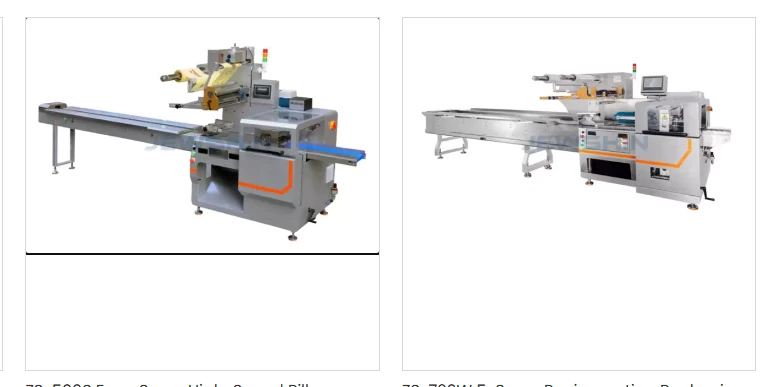
Changeover time also affects whether a horizontal flow wrappe or another inline packaging module fits the production plan. Flow wrapping generally moves individual products continuously through film forming, longitudinal sealing, and end sealing, so its package-handling method differs substantially from a rotary premade-pouch machine.
Filling accuracy introduces another measurable cost. If a nominal 500 g product averages 505 g because the dosing process gives away 5 g per package, 100,000 packages consume 500 kg more product than the declared quantity requires. Improving average giveaway by only 2 g saves 200 kg over the same production volume.
Rotary and inline architectures can both use multihead weighers, augers, pumps, volumetric fillers, or piston fillers, so architecture alone does not determine accuracy. Product density, particle size, viscosity, temperature, target weight, refill consistency, and vibration all affect the dosing process. A machine trial using at least 100 consecutive packages provides more useful information than checking 5 or 10 hand-selected samples.
Sealing needs the same level of attention. Heat-sealable laminates require controlled temperature, pressure, and contact time. Increasing speed from 60 to 90 packs per minute raises nominal output by 50%, but the sealing system must still provide enough time and uniform pressure to create an acceptable seal.
A rotary machine can divide sealing into two stations, followed by cooling or seal finishing. An inline system can use a longer sealing section or multiple seal units. Neither arrangement removes contamination problems: powder, oil, crumbs, or product trapped in the seal area can reduce package integrity even when temperature settings remain unchanged.
During acceptance testing, seal evaluation should use packages produced at sustained operating speed, not only packages made during slow setup. A 60-minute continuous run exposes feeding, temperature stability, filling variation, and minor stops more effectively than a 5-minute demonstration.
Maintenance creates another difference because a rotary machine concentrates many functions around one frame. Vacuum circuits, grippers, sensors, sealing jaws, cams or servo-controlled mechanisms, and filling interfaces must remain synchronized. If one essential station is unavailable, the rotary process normally stops rather than bypassing that operation.
An inline line spreads equipment across several modules. Accumulation can allow upstream production to continue briefly during a downstream stop. A buffer holding 200 packages provides 2.5 minutes of separation at 80 packs per minute, enough to absorb some short interruptions without immediately stopping the entire line.
More modules also create more maintenance points. Five separate machines may have five control cabinets, multiple conveyors, additional motors, guarding switches, sensors, and communication interfaces. If each module achieves 98% availability independently, the complete line does not automatically maintain 98% availability because interactions and transfer faults can reduce overall performance.
For that reason, OEE-style measurements provide a better comparison than catalog speed. A system scheduled for 480 minutes with 90% availability runs for 432 minutes. If it operates at 95% of its planned rate and 98% of produced packages pass quality requirements, the combined result is about 83.8% when the three percentages are multiplied.
At a planned 100 packs per minute, 83.8% effective performance corresponds to roughly 40,224 good packages during an 8-hour shift rather than the theoretical 48,000. A machine advertised at 110 packs per minute but achieving only 72% under real plant conditions would deliver about 38,016 good packs in the same scheduled period.
Sanitation can change the numbers further. Food lines handling allergens, dairy ingredients, meat, sauces, or fine powders may require cleaning between product groups. If sanitation occupies 90 minutes of an 8-hour shift, 18.75% of scheduled time is unavailable before production stops and changeovers are counted.
Rotary machines place product handling in a compact area, reducing the length of surfaces around the primary packaging process. Compact construction can also make some internal areas harder to reach, so removable hoppers, tool-free product-contact parts, drainage, open-frame construction, and access to filling and sealing areas should be inspected during equipment selection.
Inline lines offer more separation between modules but can contain longer conveyor surfaces. A 12-meter line with several transfers has more distributed cleaning areas than a compact machine. In 2026, buyers in European and North American food plants commonly evaluate hygienic access alongside throughput because cleaning time directly removes available production minutes.
Utilities deserve the same treatment. Compressed air consumption, electrical load, vacuum generation, cooling, and extraction can add operating cost. A packaging line operating 4,000 hours per year turns even a small continuous utility difference into thousands of operating hours of additional consumption over a 10-year service period.
Staffing also changes total cost. If one configuration needs two operators per shift while another needs one, a three-shift operation represents three additional operator shifts every 24 hours. Automation does not eliminate labor completely because film or pouch replenishment, product supply, inspection, cleaning, troubleshooting, and changeovers still require trained staff.
The financial comparison should therefore use cost per accepted package. Assume System A costs 20% more to purchase but produces 15% more accepted packages per labor hour and saves 30 minutes of cleaning per day. Over 250 production days per year, the cleaning difference alone returns 125 production hours annually.
A lower purchase price can still be preferable when production volume is modest. A plant running one 8-hour shift at 50% utilization has less reason to pay for capacity that remains unused. A facility running 20–24 hours per day has much more exposure to downtime, maintenance intervals, spare-part availability, and lost output.
Supplier support should be measured with practical questions rather than broad service claims. Buyers can request recommended spare-parts lists for the first 2 years, expected wear-part replacement intervals, remote-support availability, technician response arrangements, PLC and servo component availability, and documented preventive-maintenance schedules.
Factory acceptance testing can then use agreed production conditions. A useful test may include a 60–120 minute sustained run for each major package family, verification of weight accuracy from at least 100 samples, reject recording, seal inspection, alarm recovery, and one complete format change performed by trained operators.
The final comparison becomes clearer when the plant models its actual production mix. A factory producing 80% of annual volume in two premade pouch sizes may benefit from the compact, synchronized layout of rotary equipment. Another facility producing 15 or 20 package formats and frequently adding inspection or labeling stages may make better use of an inline architecture.
Rated speed remains only one input. A 100-pack-per-minute rotary machine operating at 85% effective output and a 90-pack-per-minute inline system operating at 94% effective output are almost equal in usable rate: 85 versus 84.6 accepted packs per minute before product-specific quality losses are added.
For equipment expected to remain in service for 10–15 years, the comparison should cover annual production hours, package range, changeover count, cleaning time, floor-space allowance, accepted-package rate, staffing, utilities, spare parts, and expansion plans. The stronger machine is the one that produces the required accepted volume with fewer lost production hours and a manageable cost per package.