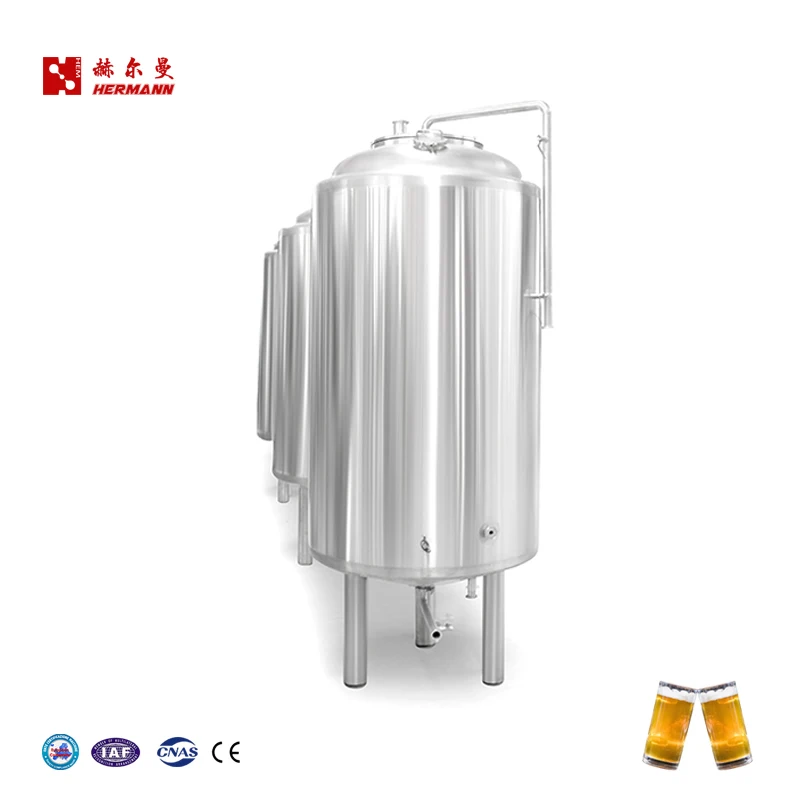
Custom beer brewing equipment is worth considering when standard systems do not match batch size, building dimensions, beer styles, labor plans, or future production targets. The Brewers Association’s 2015 benchmarking data showed brewery water use ranging from 3.31 to 81.7 barrels of water per barrel of packaged beer, while electricity ranged from 6.7 to 709 kWh per barrel. Equipment layout, heating capacity, cooling zones, pumps, CIP coverage, and controls all influence those operating numbers. A properly specified custom system can reduce unnecessary transfers, fit limited production space, improve batch repeatability, and leave room for additional fermenters without replacing the original brewhouse.
A brewery does not operate as separate tanks. Mash vessels, kettles, heat exchangers, fermenters, bright tanks, chillers, pumps, piping, water storage, and cleaning equipment share production time and utilities. Buying each component from a standard catalog can create mismatched capacity. A 10 BBL brewhouse feeding only two 10 BBL fermenters, for example, has little room for scheduling once fermentation occupies both tanks for 7 to 14 days.
Custom design starts with production volume rather than vessel appearance. A brewpub producing 1,500 BBL annually may need a very different cellar from a production brewery targeting 10,000 BBL, even when both use a 10 BBL brewhouse. Brewing twice into a 20 BBL fermenter can raise brewhouse utilization without doubling the number of cellar tanks.
Tank volume should be planned around brewing frequency, fermentation time, packaging frequency, and the number of beer styles being produced at the same time.
Production scheduling then affects vessel configuration. A two-vessel brewhouse may work well when a brewery performs one or two turns per day, while separating mash, lauter, kettle, and whirlpool functions can reduce overlapping process time at higher throughput. Saving 30 minutes on one batch looks modest; across 500 annual brews, it represents 250 production hours.
The same planning applies to micro brewery equipment used in smaller commercial breweries. Limited floor area often makes equipment dimensions more important than nominal capacity. A fermenter that is 8 inches narrower may allow another tank in the same cellar row, while a lower overall height may avoid structural work in buildings with restricted ceiling clearance.
Space planning should include service clearance, not only vessel footprints. Operators need access to manways, sample valves, racking arms, motors, spray devices, instrumentation, and glycol connections. Leaving too little working space may save several square feet during installation but make routine maintenance slower for the next 10 or 15 years.
| Design item | Standard purchase approach | Custom specification approach |
|---|---|---|
| Fermenters | Fixed diameter and height | Sized around ceiling and floor space |
| Cooling | Standard jacket arrangement | Zones matched to tank volume and use |
| Pumps | General-purpose sizing | Flow matched to process and pipe length |
| Controls | Predetermined package | Manual, semi-automatic, or automated |
| Expansion | Added after installation | Connections and capacity planned earlier |
Once the physical layout works, utility demand deserves equal attention. The Brewers Association reported best-performing 2015 participants at 6.7 kWh of electricity per packaged barrel, 0.84 therm of natural gas per barrel, and 3.31 barrels of water per barrel. The same dataset contained much higher usage at some breweries, showing how widely resource intensity can vary.
Brewers Association energy guidance also notes that smaller breweries generally consume more electricity per barrel because refrigeration, pumps, lighting, air compressors, and other base electrical demands are spread across fewer barrels. Its brewery energy manual notes that electricity can represent around 70% of energy cost while accounting for roughly 30% of total energy consumed, depending on the operation.
Equipment selection can address part of that difference. Variable-frequency drives allow pumps and motors to operate below full speed when the process does not require maximum flow. Insulated hot liquor tanks reduce heat loss between brewing cycles, while properly sized plate heat exchangers can shorten wort cooling without purchasing an unnecessarily large chiller.
Heating equipment also needs to match local utilities. Steam, direct fire, and electric heating have different installation requirements. In the United States, current federal efficiency specifications for some commercial gas-fired boilers reach 94% thermal efficiency within specified capacity ranges, although actual brewery steam-system performance also depends on piping, insulation, condensate return, maintenance, and operating conditions.
Cooling deserves the same level of specification because fermentation is temperature-sensitive. The Brewers Association describes fermentation management around time, temperature, and process control rather than treating it as simple cold storage. A custom fermenter can use separate glycol jackets on the cone and cylinder, with jacket area selected according to tank geometry and expected cooling demand.
Multiple cooling zones become more useful in taller tanks or when vessels are sometimes partially filled. Brewery practitioners have documented cases where separate zones allow an unused upper jacket to remain off during partial fills. Technical discussion from 2017 also noted greater freezing concerns when coolant is supplied substantially below approximately 27–28°F, making sensor position and temperature control important.
Temperature measurement should therefore be designed with jacket placement rather than added afterward. MBAA technical discussion in 2021 noted that multiple cooling zones still require temperature measurement in appropriate locations to control stratification effectively; the same discussion described beer density behavior near approximately 3°C, or 37°F.
More cooling surface is not automatically better. Jacket area, glycol temperature, flow rate, probe position, tank geometry, and actual filling level have to work together.
Cleaning layout is another area where customization affects daily labor. Brewers may perform hundreds of tank cleaning cycles each year, so spray-device coverage, drain position, piping slope, valve orientation, and CIP connections affect more than installation convenience. A cleaning step shortened by 15 minutes across 600 annual vessel cycles saves 150 hours of equipment occupancy before water or chemical use is considered.
A custom CIP arrangement can also separate cleaning circuits according to equipment size. A 5 BBL cellar tank does not necessarily require the same cleaning flow as a 40 BBL fermenter. Pump capacity and spray-device requirements can be calculated before fabrication so the system supplies adequate mechanical cleaning without simply using the largest available pump.
Material specification deserves similar attention. Commercial brewery product-contact surfaces commonly use stainless steel because it tolerates hygienic cleaning and repeated contact with brewing liquids. Buyers should specify steel grade, internal finish requirements, weld treatment, fittings, gasket materials, valves, pressure ratings, and documentation instead of accepting “stainless steel” as a complete vessel specification.
Pressure ratings matter particularly for fermenters and bright beer tanks. A vessel designed only for atmospheric processing is not interchangeable with a pressure-rated tank used for carbonation or pressurized transfer. Brewers Association guidance published for beverage pressure vessels emphasizes compliance, inspection, maintenance, and appropriate pressure-vessel practices.
Controls can then be selected around staffing. A small brewery running 2 or 3 batches per week may not benefit from the same automation package as a brewery performing several turns each day. Temperature loops, VFD pump control, automated water measurement, valve feedback, recipe steps, and tank monitoring can be added where repeated manual work consumes operator time.
Automation should also remain serviceable locally. A control panel built from readily obtainable industrial components can be easier to maintain over a 10-year equipment life than a proprietary system dependent on one supplier. Component model numbers, wiring diagrams, I/O lists, software backups, and spare-parts documentation should be included with the equipment package.
Expansion planning is easier before piping and electrical work are installed. If annual production is expected to move from 3,000 BBL toward 6,000 BBL, the initial project can reserve cellar floor positions, glycol headers, control-panel capacity, drainage, and utility connection points for later tanks. The brewery can still buy only the fermenters needed for the first production stage.
The chiller requires particular care because adding four fermenters later changes peak refrigeration demand. Sizing only for opening-day capacity may require replacing or supplementing refrigeration equipment during expansion. Oversizing every component is not a good substitute; staged capacity, modular equipment, and documented future demand provide a more controlled approach.
Production losses deserve measurement as well. A one-percentage-point difference in usable yield becomes noticeable as volume grows. At 10,000 BBL of annual production, 1% equals 100 BBL. Tank geometry, dead legs, transfer paths, yeast removal, hop handling, and packaging practices can all affect how much finished beer leaves the cellar rather than remaining in equipment.
Maintenance access can produce similar long-term differences. Pumps placed where seals can be changed without removing nearby piping, valves positioned within normal reach, and motors installed with adequate clearance reduce service time. Brewers Association quality resources recommend preventive maintenance as production grows because scheduled maintenance supports process consistency and reduces downtime.
Supplier evaluation should therefore cover more than vessel price. Before fabrication, the brewery should receive dimensional drawings, tank specifications, utility requirements, piping information, electrical requirements, component lists, pressure ratings, and production assumptions. A dimensional error discovered in a drawing can be corrected before fabrication; the same error found after a 2,000-gallon tank arrives can require structural or piping changes.
Factory testing should cover pressure integrity, pumps, motors, controls, sensors, valves, and electrical functions included in the agreed scope. Documentation becomes especially important after 5 or 10 years, when the employee who supervised the original installation may no longer work at the brewery and replacement components must be identified from drawings rather than memory.
Purchase price should finally be compared with operating cost over the expected service period. Saving $20,000 at installation loses much of its appeal if the layout requires 400 additional labor hours each year. At a fully loaded labor cost of $30 per hour, that difference is $12,000 annually and $60,000 over five years before energy, water, maintenance, or production downtime are included.
The useful comparison is therefore measurable: barrels produced per brewing day, kWh per barrel, water-to-beer ratio, labor hours per batch, cellar occupancy, usable package yield, cleaning time, maintenance access, and available expansion capacity. A custom system earns its place when the specified equipment improves enough of those numbers to justify the added engineering and purchase cost.