A particleboard sample is meaningful only when it represents the substrate, thickness, density or grade, surface treatment, finish, and processing expected in the final product. Buyers should review the board itself and any laminate, veneer, coating, edge treatment, or machining applied to it, then match technical and emissions evidence to the exact panel and destination. A clear reference makes it easier to assess production variation and approve later lots.
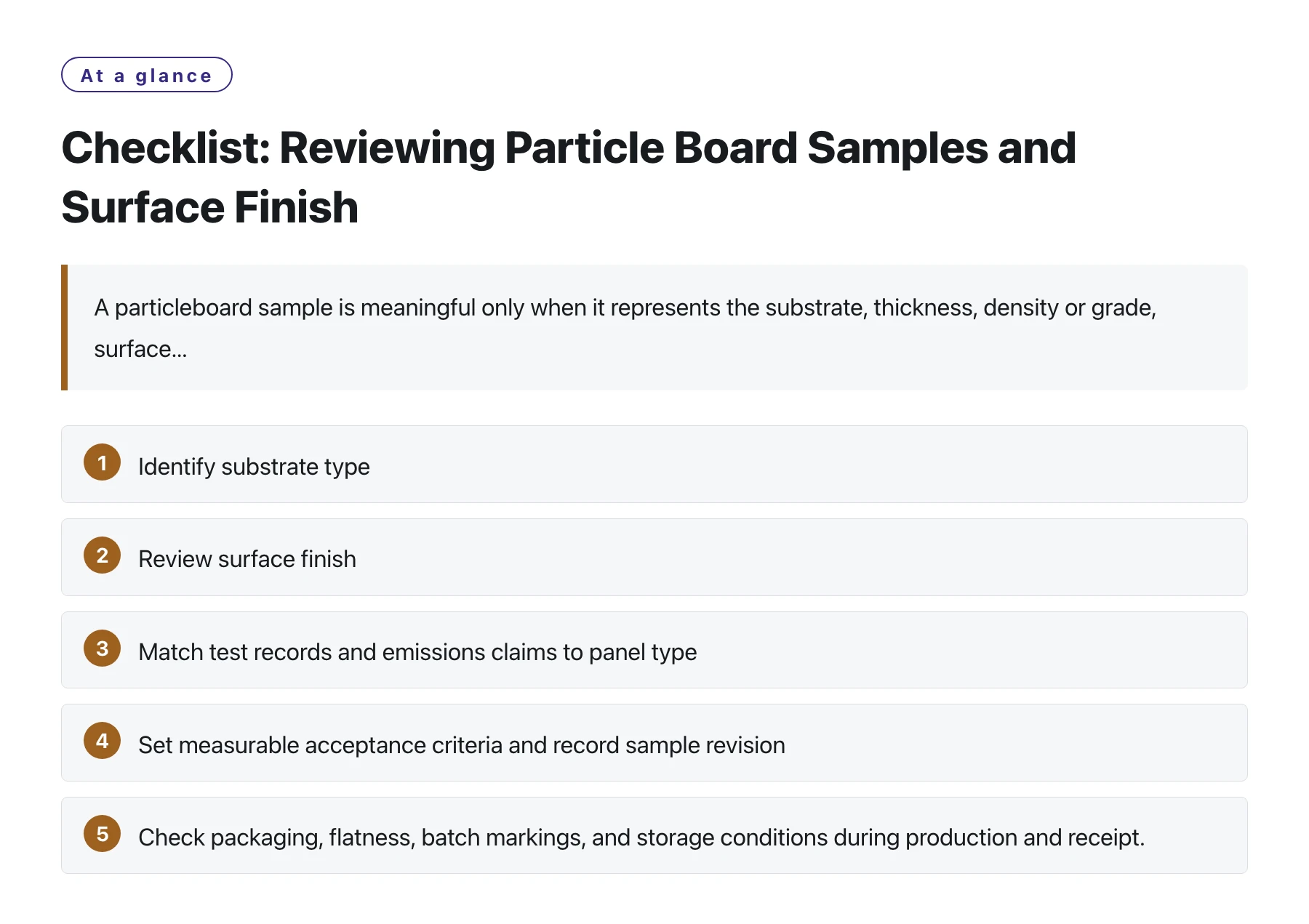
Key takeawaysIdentify substrate type, grade, thickness, dimensions, moisture conditions, and intended application. · Review surface finish, overlay, color, gloss, texture, edge quality, and machining requirements. · Match test records and emissions claims to panel type, supplier, sample, and market. · Set measurable acceptance criteria and record sample revision, reference photos, and approvals. · Check packaging, flatness, batch markings, and storage conditions during production and receipt.
Treat the board and its surface system as a combined product when they will be used together.
Define the sample and finished application
Start with the end use: furniture component, cabinet, countertop substrate, shelving, interior panel, flooring underlayment, or another application. Record the environment, loading, fasteners, machining, edge treatment, cleaning, and expected exposure. The designer or product engineer should state which performance requirements matter. Particleboard products differ by construction, intended use, and specification; a visual sample alone cannot establish suitability.
Identify manufacturer, production site, panel type, grade or classification, nominal thickness, length, width, density range where specified, and surface treatment. State whether the sample is bare board, laminated, veneered, coated, or finished on one or both faces. Include edge banding, routing, drilling, or other processing that will be part of the delivered component.
Buyers considering JS Sourcing particle board sourcing can request suppliers to label every sample with product code, date, thickness, finish, substrate, and source. Do not accept an unmarked offcut as a final production reference when its origin or treatment cannot be confirmed.
Inspect the substrate and dimensions
Examine the panel edges and faces for uniformity, visible voids, loose particles, delamination, cracks, dents, warp, and damage. Use measurements selected by the specification for thickness, length, width, squareness, and flatness. Agree the measurement points and instruments before inspection. Record results rather than relying on a broad note such as “dimensions acceptable.”
Check how the panel will be cut, drilled, routed, and fastened in the finished product. Inspect edge integrity, screw holding or other application-specific evidence only using an agreed method and representative specimen. Do not infer structural or machining performance from appearance. Ask the manufacturer or product engineer for recommendations on fasteners, support spacing, and storage if those affect use.
Compare samples from more than one sheet when production variation matters. Note the board’s orientation and which faces were evaluated. If the final design uses several thicknesses or grades, sample each variant and keep them separately labeled. A single sample should not be assumed to represent all production configurations.
Review surface finish under controlled conditions
Identify the finish system: raw surface, paper overlay, thermally fused laminate, high-pressure laminate, veneer, paint, foil, or another specified layer. Record color reference, texture, gloss target, pattern direction, print repeat, and accepted variation. Review samples under consistent light and alongside adjacent materials. A finish may appear different after installation, so use the project’s actual viewing and lighting conditions where practical.
Inspect surface continuity, bubbles, pinholes, scratches, stains, edge coverage, color variation, gloss consistency, and adhesion or bonding features relevant to the chosen surface. For textured décor, compare relief and printed grain alignment. If a standard or test method is specified, identify it and confirm the sample is tested in the intended configuration.
The Composite Panel Association describes ANSI A208.1 as classifying particleboard by physical, mechanical, and dimensional characteristics as well as formaldehyde levels, and notes that surface treatments or overlays may affect emissions. Its information is a starting point for understanding the product category; the buyer should still confirm the exact standard scope, market rules, and evidence needed for the project. [1]
Connect test data to the actual panel
Request a technical sheet, test report, declaration, or certification that identifies panel type, grade, thickness, finish, manufacturer, factory, test method, sample identity, date, and applicable market. Match each document to the offered SKU and production site. A report for bare particleboard may not cover a finished panel, and a test for one thickness or grade may not support another.
List the properties relevant to the intended use and have the technical owner define the acceptance criteria. Depending on the application, these may include physical or mechanical characteristics, dimensional tolerances, surface performance, moisture-related behavior, emissions, or other factors. Do not assume a particular certification is required everywhere; verify the destination-specific obligation and customer specification.
For emissions claims, ask what panel and surface system were tested, which method was applied, and which market limit or voluntary program the claim refers to. Terms such as “low emission,” “no added formaldehyde,” or “compliant” need precise definitions and evidence. Confirm that labels and records identify the same supplier and product that will be shipped.
Create a reference and approval record
Use a sample form that captures supplier, factory, product code, board type, grade, thickness, finish, surface treatment, date, intended use, and sample purpose. Photograph faces, edges, labels, and any known defect. Record who reviewed appearance, dimensions, technical evidence, and intended use, since those may be separate approvals.
Write acceptance criteria as observable requirements. A color reference, gloss range, dimensional tolerance, surface defect limit, or document requirement should be clear enough for the supplier and inspector to apply. If a characteristic is judged visually, specify sample lighting, viewing distance, reference board, and decision owner where those conditions matter.
State which details are accepted and which remain open. An approval of a surface color should not automatically approve substrate grade, emissions evidence, thickness, edge machining, or packaging. Attach the approval to a specific sample revision and retain a physical reference where feasible.
Check production consistency and changes
Ask how the manufacturer controls raw material, resin or adhesive formulation where relevant, pressing, thickness, surface treatment, finishing, cutting, and panel identification. Request records that relate to the required characteristic. Confirm which processes are internal and which are outsourced, and how the supplier identifies the current specification at the production line.
Require written review before changes to board source, panel type, grade, thickness, surface paper, resin, finish, plant, process, or test method if they can affect accepted requirements. A substitution that appears visually similar can change machining behavior, surface performance, emissions evidence, or fit. Define who can approve a proposed change and what new sample or testing is needed.
For each order, record panel lot or batch and the documents and sample used for approval. If several lots are combined, decide how they will be checked and segregated. Preserve supplier’s production records with the order and any corrective action. This supports traceability if later sheets differ in appearance or dimensions.
Plan packaging and handling
Particleboard panels and finished components can be affected by impact, moisture, poor stacking, and surface abrasion. Specify corner protection, face separators, pallet support, wrapping, edge protection, and orientation according to the route and product. Ask for packed dimensions, weight, and stacking limits and compare them with warehouse equipment, container plan, and jobsite access.
State storage requirements from the manufacturer, including whether panels must be kept dry, flat, supported, or protected from uneven exposure. Confirm how packaging will permit inspection without compromising the remaining stack. If the shipment may be held before processing or installation, identify who monitors condition and what signs require quarantine or technical review.
Review carton or bundle marks for product code, thickness, grade, finish, lot, quantity, order, and destination. During receipt, check outer damage, moisture, flatness, surface condition, count, and labels. Photograph and isolate affected panels before they are cut or mixed into production.
Compare quotations using the approved build-up
Ask suppliers to price the same substrate, grade, thickness, dimensions, surface treatment, finish, machining, quantity, packaging, and delivery point. Separate sample charges, tooling, custom décor, testing, inspection, edge treatment, and freight. Request minimum quantities, lead times, validity, payment assumptions, and any exclusions that affect the finished panel.
If one offer changes the surface or substrate, list it as an alternate and compare technical evidence and end-use suitability. A lower unit price may reflect a different board density, finish, tolerance, or test scope. Keep commercial options separate from the approved product specification until the technical owner accepts a change.
Confirm delivery terms, named place, pallet configuration, unloading, and destination handling. Ensure shipping estimates use actual sheet or component dimensions and weights. Keep procurement, technical approval, and logistics assumptions aligned so a price accepted for one build-up does not result in another panel being produced.
Use receiving and production feedback
Before production, include the approved sample, specification, finish reference, inspection plan, and change process in the order file. During production or pre-shipment review, check product identity, dimensions, finish, edge condition, packaging, labels, and required records. Identify the sample method and the scope of any inspection report.
After delivery, compare panels and finished components with the approval record. Note cutting waste, surface defects, bonding issues, dimensional concerns, odor or emissions documentation gaps, and transit damage. Record which lot, supplier, and processing stage are involved. Avoid assuming a problem originated at the panel mill if transport or downstream fabrication could contribute.
Use results to adjust sample requirements, supplier evidence, packaging, and inspection criteria for later orders. Keep changes tied to identified issues rather than overgeneralizing from one sample or shipment.
Sources
Frequently asked questions
What should be on a particleboard sample label?
Record supplier and site, panel type, grade, product code, thickness, finish or overlay, date, lot if known, and the purpose of the sample.
Can a surface finish change emissions evidence?
It can affect the panel system and its evidence. Confirm the tested substrate and finish, report scope, method, and destination-market requirements with the responsible reviewer.
Is a visual sample enough to approve particleboard?
No. Review appearance, dimensions, and construction, then match performance, emissions, processing, and packaging evidence to the intended use and destination market.
What changes should require renewed approval?
Review changes to substrate, grade, thickness, resin, finish, factory, process, or test method when they may affect accepted requirements or supporting evidence.